“And the virgin’s name was Mary.” -Luke 1:27
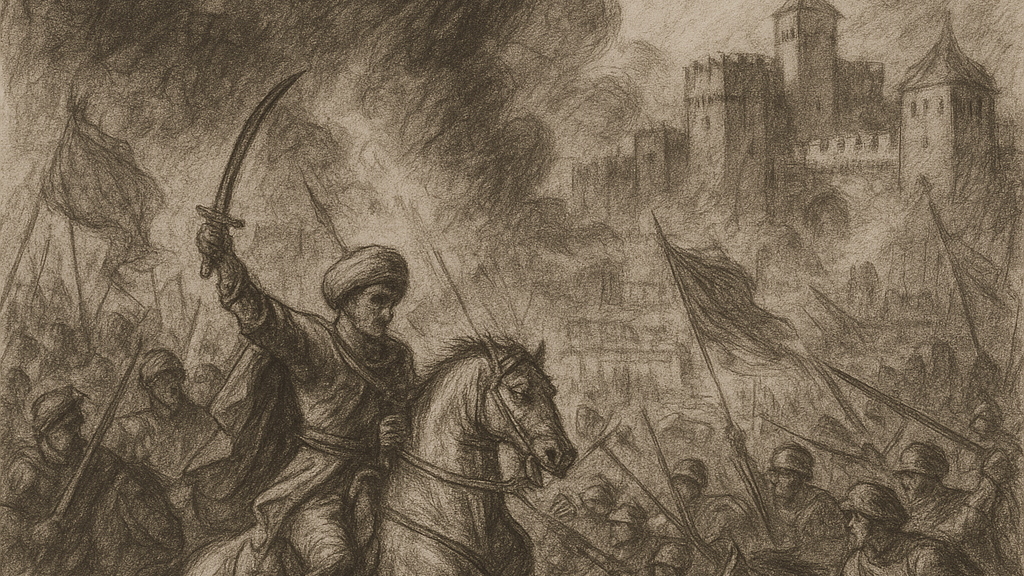
In September of 1683, the great walled city of Vienna was surrounded by 130,000 Ottoman soldiers, their cannons, and their tents. The Ottomans had long wanted to overtake Vienna. It was the seat of the Holy Roman Emperor and the power center of Christian Europe. And now they were at the gates, putting the pieces in place for the takeover. Food supplies into the city had been cut off. The walls were being pounded by cannonballs. And the vast Ottoman army was digging furiously to attack from underneath. They faced an Austrian army that they outnumbered roughly 10 to 1, and the Holy League’s reinforcements on the way would not be enough.
Vienna’s capture was inevitable.
As the city lay under siege, the Polish army under King Jan III Sobieski was marching quickly from the northeast to help. By September, his 27,000 soldiers had reached the wooded hills overlooking Vienna, where they and other Christian allies in the Holy League prepared for what amounted to a suicide mission: to descend into the valley and fight the world’s largest army.
As dawn broke on September 12, the Christian army celebrated Mass, after which they solemnly placed the campaign and their lives under the protection of the Blessed Virgin Mary. And then they charged down the hill and rushed headlong into the fiercest battle of their lives.
* * * * *
Names matter.
According to Thomas Aquinas, a name “should answer to the nature of a thing.” It points to its essence, its nature, and its purpose. Think of names like Jesus (“God saves”), Abraham (“father of many”), or Peter (“rock”). Think of Ruth (“companion”) or Perpetua (“unwavering”). “Explore your name,” says Peter Kreeft. “It’s no accident that you have it.” (I like to remind my kids that my name, Richard, means “powerful ruler.”)
But what about the name of Mary, the Mother of God and the pinnacle of His creation? What does her name mean? The answer is surprisingly mysterious.
You can credibly trace the root of Mary, or Miriam—the name she would have been called in Aramaic—to a variety of different words in all the major languages of her age: Hebrew, Greek, Latin, and even Egyptian. St. Bonaventure counts more than a dozen potential interpretations; St. John Eudes cites seventeen. One can make the case for her name meaning “sea” (mare in Latin), “beloved” (mry in Egyptian), “sublime” (ram in Hebrew, as in Miriam), “bitterness” (marah in Hebrew), or “aromatic balm” (think of myrrh).
But there’s one potential interpretation I find especially fascinating: “Mary” traces back to one Hebrew word for…rebellion.
But there’s one potential interpretation I find especially fascinating: “Mary” traces back to one Hebrew word for…rebellion.
Go figure. The only creature in human history who never sinned, she of unequaled humility and meekness and obedience, the one who uttered the most famous “yes” to God in history—her essence is…resistance? Rebellion? Wouldn’t the more appropriate name be the famous hymn’s “gentle woman, peaceful dove”?
But her name was no accident. And that means it tells us something essential about her mission: that Mary, in one sense, was destined to be the greatest rebel in history.
By God’s grace, she was granted a superpower that, to that point, had evaded every man and woman since the fall of Adam. Sin would have no hold on her. If all of humanity was by its nature destined to march in a single direction—toward sin, selfishness, and death—her nature would be to march against it, toward God and God alone.
In a world plagued by sin, is there anything more rebellious than perfect holiness?
This is Mary’s great rebellion.
When her Son’s followers fled the Romans during His Passion, she remained at His side, heartbroken—but resistant, defiant. “Perfect love casts out fear,” St. John writes. And never was there a more perfect and fearless love than the scene of Christ and His Mother at Calvary.
This is the great paradox we touch upon in the Most Holy Name of Mary: that the sweet, gentle, amiable mother of Christ also possesses a fearlessness and a fierceness beyond our understanding. The worst demons of hell tremble in her midst. She crushes the head of the serpent. “Thy Holy Name,” says St. Bernard, “cannot be spoken without inflaming the heart.”
That is the Mary to whom the faithful soldiers turned during the siege of Vienna—the same Mary present at each of our own battles. When we invoke her Most Holy Name, it is indeed what the saints describe: “jubilee to the heart,” “the insignia of virtue,” “music to the ear.” But the Most Holy Name of Mary also points to the strongest and fiercest fighter, the most immaculate rebel, whom God ever created.
* * * * *
The Ottomans surrounding Vienna looked up and saw the Christian army and its horses sprinting down the hills with fury. One of them described it “as if an all-consuming flood of black pitch was flowing down the hills,” behind a red flag with a white cross. It was arguably the greatest calvary charge in European history, and its effect was devastating. The Ottomans were soundly defeated at the gates of Vienna, and the victory by the Christian army marked the end of the Ottomans’ western advance. Of the great battle, Jan III Sobieski of Poland later told the pope, “We came, we saw. God conquered.”
In thanksgiving to God for the victory, Pope Innocent XI declared thereafter that every year, on September 12—the day of the Great Resistance at Vienna—the universal Church would celebrate the feast of the Most Holy Name of Mary. To that, one might imagine Our Lady’s characteristic reply: “For He that is mighty hath done great things for me; and holy is His name.”
 Ricky McRoskey
Leave a comment